
Dropshipping vs holding your own inventory: which fits you?
Compare listing a supplier's goods against buying 50 units upfront across cash, control and delivery speed, then pick the model that suits your risk appetite.
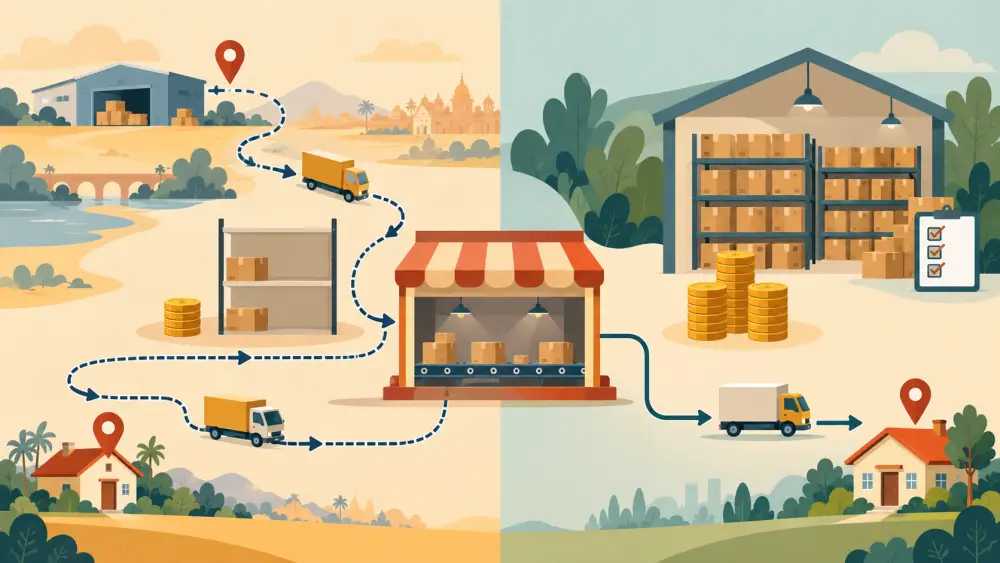
When you start a store, one early question is whether to buy stock first or sell something you do not physically hold. Both models are legitimate. They simply trade different things: cash against control.
The two models
Dropshipping. You list a supplier's products in your store. When a customer orders, you pass the order to the supplier, who packs and ships it directly to the customer. You never touch the item. You pay the supplier their price and keep the difference.
Holding inventory. You buy stock upfront, keep it with you, and pack and ship each order yourself.
Meet two sellers
Take Anita and Rohit, imagined for this example.
Anita lists a supplier's home organisers in her store. She spends nothing on stock to begin with. Orders arrive, she forwards them, and pays the supplier per order.
Rohit buys 50 units of a similar organiser from a wholesaler. He pays for all of them upfront, stores them in a cupboard and ships each order from home.
Cash
Anita needs little cash to start. That is a real advantage if money is tight, and it lets her test many products. But her cash flow is not automatically smooth. She may need to pay the supplier before the customer's money reaches her, especially with COD, and she must have funds ready for refunds.
Rohit's cash is locked in the 50 units. If they sell, he gets it back with profit. If they do not, he is stuck. Working capital simple formula for sellers can help you size that risk.
Control
Rohit can check quality, pack neatly, add a handwritten note and decide when to ship. He knows what is in stock.
Anita depends on her supplier for all of this. If the supplier runs out, ships late, sends the wrong item or packs badly, her customer blames her store. She also may not be able to personalise packaging. She should order samples herself and read the supplier's terms before listing anything. Dealing with overselling and out of stock orders describes what happens when listings outrun real stock.
Delivery speed
Rohit can pack and hand over the parcel on the same day. Anita's speed depends on how fast her supplier processes and dispatches. Ask your supplier for honest dispatch times and tell customers accordingly. See setting honest delivery time expectations.
Margins and competition
Dropshipped items are often available to other sellers too, so differentiating can be hard and prices may be pushed down. Holding stock, especially of something you make or source uniquely, can give you a more distinctive product. Neither model promises any particular profit; that depends on your pricing, costs and demand. Price from target margin formula helps you set a price that works whichever you choose.
Returns and problems
With dropshipping, you must work out who handles a return or a damaged parcel, and who bears the cost. Agree this with the supplier beforehand. With your own stock, the return comes to you, and you can check and restock it yourself.
How to choose
Ask yourself:
- How much can I afford to lose if nothing sells?
- Do I need control over quality and packing to build my brand?
- Do I trust my supplier enough to put my name on their service?
- Is my product unique, or easy for anyone to copy?
Many sellers start with a small stock of one or two products, or use a supplier to test demand, and then move to holding stock of the proven items. You can start small and change your mind. Whichever you choose, write down the full cost per order and know your break-even, so the model serves you instead of the other way round.