
How much does a higher average order value help my ad return?
A modest rise in the average order value lifts your return on ad spend without a single extra order, and this example shows the numbers going from 5.0 to 5.6.
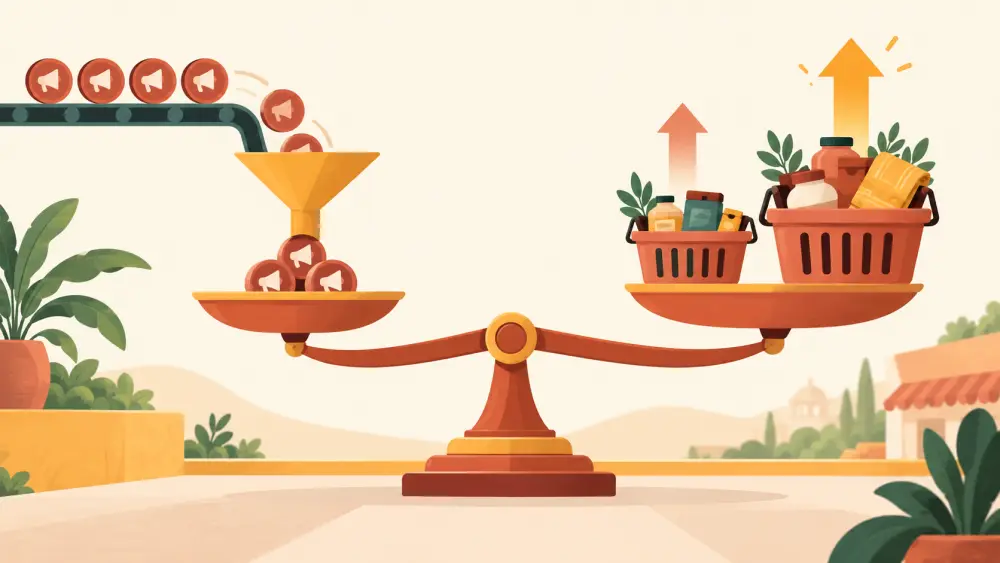
When ads are not paying well, sellers usually try to get more clicks or more orders. There is another lever that is easier to miss: making each order a little bigger. Even a small rise in the average order value, called AOV, can lift your return on ad spend, or ROAS, using the same traffic.
The two definitions
- AOV is the total sales divided by the number of orders.
- ROAS is the sales you got from ads divided by the money you spent on ads.
The baseline
Say your shop gets 100 orders in a month from ads, at an AOV of Rs 500. Sales are 100 times Rs 500, which is Rs 50,000. You spent Rs 10,000 on ads.
- ROAS is Rs 50,000 divided by Rs 10,000, which is 5.0.
For every rupee in ads, you got five rupees in sales.
The lift
Now suppose you add a small change that moves AOV from Rs 500 to Rs 560. It could be a combo offer, a free shipping threshold or a suggestion of one more item. Orders and ad spend stay the same.
- Sales become 100 times Rs 560, which is Rs 56,000.
- ROAS becomes Rs 56,000 divided by Rs 10,000, which is 5.6.
You earned Rs 6,000 more in sales with the same Rs 10,000 of ads and the same 100 orders. Of course, not all of that Rs 6,000 is profit, because the extra items cost you something to make and pack. But shipping and the ad cost stay almost the same, so a large share of it is money you did not have to chase.
Why it works
Most of your cost to get an order is paid once, at the moment a customer shows up. Whether they buy one item or two, you paid the same for the click. Anything that adds more to the basket spreads that cost over a bigger sale.
Ways to nudge AOV up
- Free shipping above a set amount, positioned a little above your current average. free-shipping-threshold-vs-average-order-value explains how to choose the level.
- Bundles or sets priced slightly better than buying separately.
- A small add-on item near the checkout, such as a travel size or a card.
- A quantity offer like buy two for a small saving. See buy-two-get-ten-percent-off-worked-example.
Each of these has a cost. Free shipping eats margin, bundles discount the price, and add-ons need stock. Check that the extra money you earn is bigger than the extra money you give away.
Check the profit, not just ROAS
A higher ROAS does not always mean a higher profit, and you should know the difference. If you raise AOV by selling cheaper low-margin items, ROAS may look better while profit does not. Do the contribution check too. roas-vs-actual-profit-example shows how a good looking ROAS can still lose money.
A routine
- Note your AOV for last month, and the ad spend on those orders.
- Pick one lever, such as a threshold set above your current AOV.
- Run it for a few weeks while keeping ads steady.
- Compare AOV, ROAS and contribution before and after.
It is a gentler way to improve ads than raising the budget. You are asking each customer for a little more, not looking for many more customers.